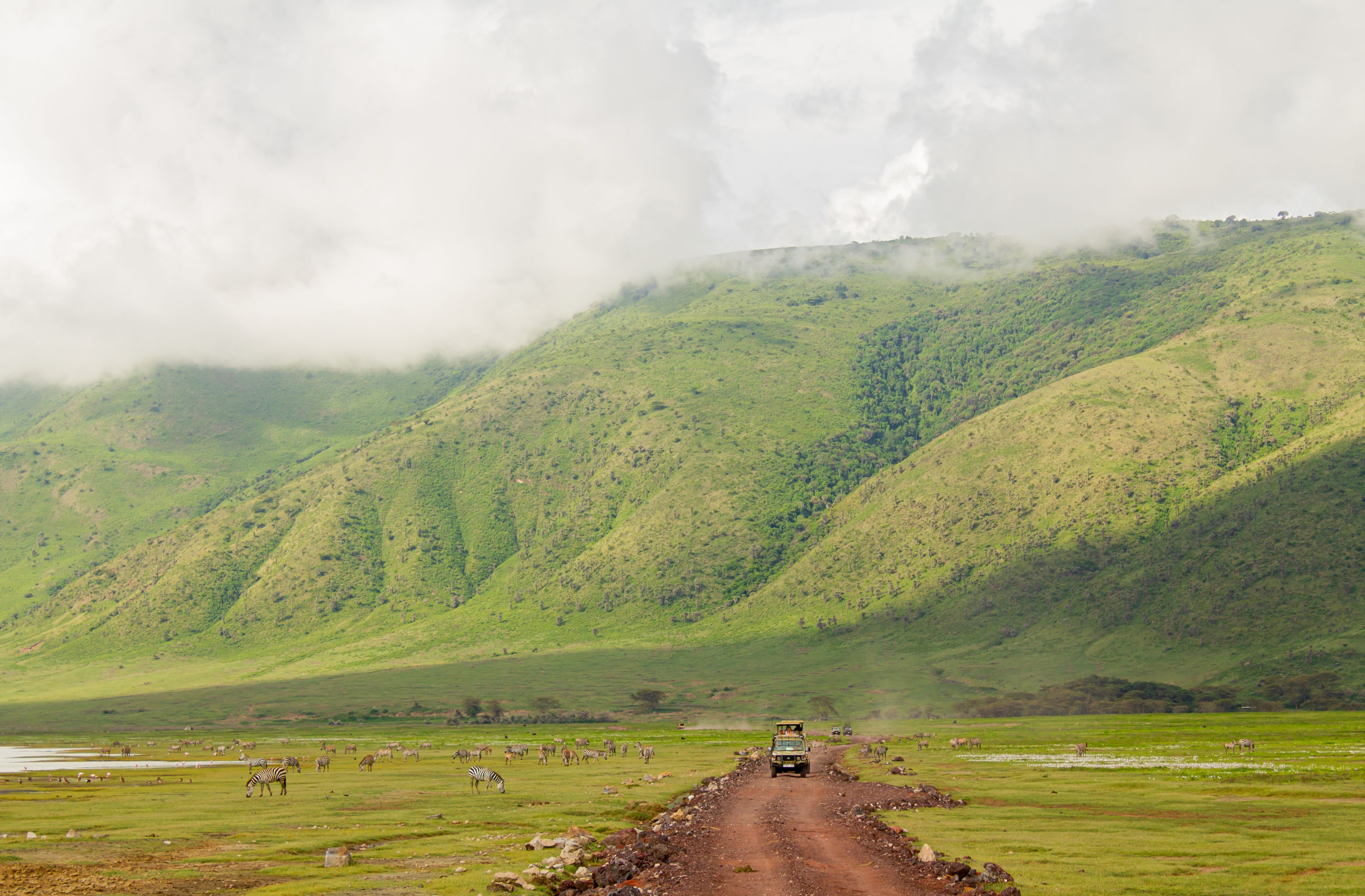
Ngorongoro Crater: The World's Largest Intact Caldera
Somewhere in northern Tanzania, a volcano had a very dramatic exit. Roughly two to three million years ago, a mountain that geologists believe once stood taller than Kilimanjaro erupted so violently that it collapsed in on itself, folding its own summit down into the earth like a soufflé pulled from the oven too soon. What was left behind is not a crater in the tidy, textbook sense. It is a caldera, the largest unbroken and unflooded one on the planet, and today it is arguably the single most concentrated wildlife spectacle in Africa.
Numbers help here, because Ngorongoro is a place that resists modest description. The caldera floor stretches across roughly 260 square kilometers, ringed by walls that rise about 600 meters above the plains below. Inside that natural amphitheater live an estimated 25,000 large animals at any given time, a population so dense that some visitors describe their first game drive here as watching a nature documentary with the pause button broken.
A Zoo With No Fences, and No Exit
What makes Ngorongoro different from the Serengeti or the Mara is not just the abundance of wildlife. It is the containment. Most of the animals here do not migrate. The crater walls, steep and largely unbroken, keep resident populations of wildebeest, zebra, buffalo, and eland more or less locked in a permanent address, alongside the predators who have learned exactly where their next meal will be standing.
This is one of the few places left where you can reliably spot all of the Big Five in a single, focused outing. The crater holds one of Africa's last surviving populations of black rhino, animals so endangered elsewhere that entire safaris are built around the faint hope of a distant sighting. Here, a rhino grazing near the crater's soda lake is a genuine possibility before lunch.
The lions of Ngorongoro deserve their own mention, mostly because they have a reputation problem. Decades of confinement within the caldera, combined with a nasty outbreak of biting flies in the 1960s that devastated the population, left the local pride with a smaller gene pool than their cousins on the open plains. The result, according to researchers, is a lion population that is a little more inbred, occasionally a little more irritable, and somehow still manages to look completely unbothered lounging in the mud by Lake Magadi.
A Garden Older Than Human Memory
Ngorongoro is not only a wildlife story. It sits inside the Ngorongoro Conservation Area, a rare designation that allows the indigenous Maasai to continue grazing cattle alongside the wildlife, a coexistence model that UNESCO recognized when it named the area a World Heritage Site. Nearby, the Olduvai Gorge has yielded some of the oldest hominid fossils ever discovered, earning the wider region the nickname the Cradle of Mankind. It is entirely possible to stand on the crater rim and be looking, in the same sightline, at both the beginning of human history and a flamingo colony that has not changed its habits in millennia.
Speaking of flamingos, Lake Magadi on the crater floor turns a startling shade of pink during the right season, as thousands of lesser flamingos filter algae through their oddly upside down beaks. From the rim above, the lake can look less like a body of water and more like someone spilled a very large bottle of nail polish across the savanna.
Visiting the Crater
Most visitors descend into the crater for a full day of game viewing before climbing back out to lodges perched on the rim, which offer some of the most dramatic sunrise and sunset views in East Africa. Mornings are cool and often misty, with the crater floor slowly revealing itself as the fog burns off, a reveal so cinematic that even seasoned safari guides tend to go quiet for it.
Ngorongoro pairs naturally with a wider northern Tanzania circuit, often bookended by Tarangire's elephant herds and baobabs on one side and the endless plains of the Serengeti on the other. But even on its own, the crater earns its reputation. It is, after all, a volcano that tried to disappear and instead became one of the most extraordinary places left on earth.
Share This Story
